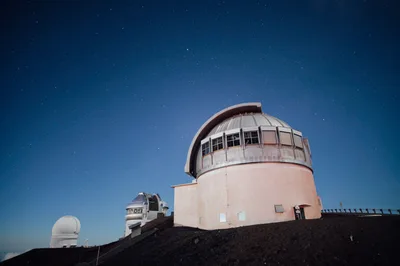
W. M. Keck Observatory (Keck I & Keck II)
Operated by the California Association for Research in Astronomy on behalf of Caltech and the University of California, the W. M. Keck Observatory stands at an altitude of 4,145 meters (13,600 ft) near the summit of Mauna Kea in Hawaii, United States. Built with funding from the W. M. Keck Foundation, Keck I achieved first light in 1993, followed by Keck II in 1996. Each telescope features a 10.0-meter (33 ft) optical aperture consisting of 36 hexagonal Zerodur mirror segments working together as a single reflective surface with a collecting area of 76 square meters. The Keck telescopes pioneered active optics technology, utilizing sensor-controlled computer actuators that adjust segment positions twice every second to counteract gravitational deflection down to four nanometers. Both telescopes are equipped with laser guide star adaptive optics systems that correct for atmospheric blurring, supporting landmark astronomical discoveries including the measurement of the supermassive black hole at the center of the Milky Way.