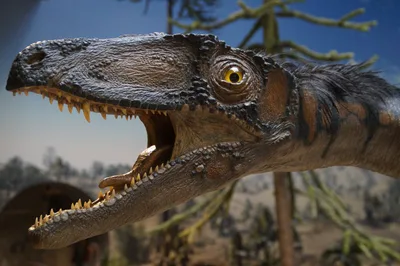
Utahraptor (Utahraptor ostrommaysi)
Discovered in 1991 in the Yellow Cat Member of the Cedar Mountain Formation in eastern Utah by James Kirkland, Robert Gaston, and Donald Burge, Utahraptor ostrommaysi represents the pinnacle of dromaeosaurid size. Living during the Barremian stage of the Early Cretaceous roughly 135 to 130 million years ago, Utahraptor reached total body lengths between 5.5 and 7.0 m (18 to 23 ft) and adult body masses around 500 kg (1,100 lb). Recent 2024 biomechanical scaling by Romain Pintore estimated exceptional specimens weighing up to 777 kg. Unlike gracile pursuit raptors, Utahraptor was heavily built and graviportal, sporting robust hindlimbs and a specialized second pedal digit armed with a 24 cm (9.4 in) curved sickle claw. The Utahraptor Block, an enormous 8-tonne sandstone mass excavated near Moab, preserves multiple individuals of varying ontogenetic ages, indicating social grouping behavior. Utahraptor functioned as an apex ambush predator hunting contemporary iguanodonts like Iguanacolossus and armored polacanthine ankylosaurs.