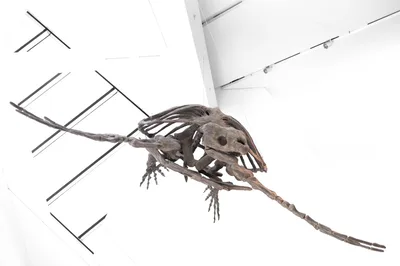
Uranocentrodon (Uranocentrodon senekalensis)
Discovered near Senekal in the Free State of South Africa and described in 1911 by Egbert Cornelis Nicolaas van Hoepen, Uranocentrodon senekalensis is the largest member of the family Rhinesuchidae. Dating to the Changhsingian stage of the Late Permian roughly 254 to 252 million years ago within the Karoo Basin, Uranocentrodon reached total body lengths of up to 3.75 m (12.3 ft). Its large, flattened skull measured 50 cm in length, supporting an estimated adult body mass of 400 kg. Remarkably, multiple fossil specimens preserve extensive integumentary structures, including parallel diagonal rows of bony scutes along its belly and keratinous scales across its back. Histological studies of preserved branchial ceratobranchials indicate that adult Uranocentrodon retained internal gills, functioning as a fully aquatic bottom-dweller in cold polar wetlands. It disappeared during the catastrophic Permian-Triassic extinction event.