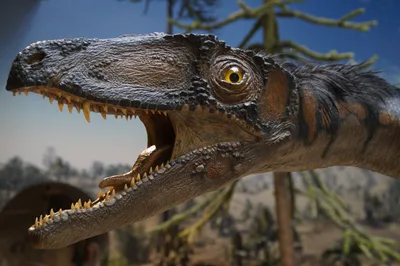
Unenlagia (Unenlagia comahuensis)
Discovered in 1996 in Neuquén Province, Argentina, and described in 1997 by Fernando Novas and Pablo Puerta, Unenlagia comahuensis represents an evolutionary link between non-avian theropods and birds. Its generic name derives from the Mapuche language meaning half-bird, reflecting its avian anatomical characteristics. Inhabiting the Portezuelo Formation during the Coniacian stage of the Late Cretaceous roughly 90 million years ago, Unenlagia reached body lengths estimated between 2.5 and 3.5 m (8 to 11.5 ft) and masses between 75 and 95 kg. Its scapula displayed a laterally oriented glenoid cavity that permitted an avian-style upward and downward flapping stroke of its forelimbs, although its body mass prevented powered flight. With elongated, slender hindlimbs, Unenlagia was an agile cursorial predator adapted for sprinting across semi-arid wooded floodplains in pursuit of small vertebrates.