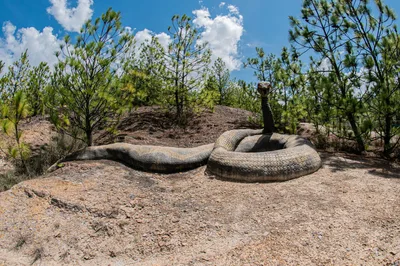
Titanoboa cerrejonensis
Discovered in 2009 in the open-pit coal deposits of the Cerrejón Formation in La Guajira, Colombia, Titanoboa cerrejonensis flourished approximately 58 to 60 Ma during the Middle-to-Late Paleocene. An international team of paleontologists recovered fossilized vertebrae and partial cranial material belonging to roughly 30 individuals. Biomechanical calculations published by Jason Head and colleagues determined that adult specimens reached an average length of 12.8 m, with the largest individuals attaining 14.3 m and a mass of 1,135 kg. The snake possessed a thick, muscular torso measuring up to 100 cm across at its widest point. Cranial remains revealed specialized, closely spaced teeth indicating a piscivorous diet supplemented by dyrosaurid crocodyliforms and giant sideneck turtles like Carbonemys. The presence of Titanoboa in equatorial South America demonstrates that tropical Paleocene temperatures were significantly warmer than today, reaching mean annual levels of 30 to 34 degrees Celsius. As an aquatic ambush predator, Titanoboa dominated river networks in the world's earliest known neotropical rainforest ecosystem.